We showed earlier that the reverse holo embarrasses the plain printing it copies, in The Reverse Holo Is Not Filler. This is the harder question: what happens when the reverse meets the actual holofoil of the same card? On 350 English cards that the catalog confirms were printed in both finishes and where TCGplayer prices both rows on the same day, the reverse is dearer 75.4% of the time, at a median 1.21x. That headline is true and it is also mostly a penny-card fact.
Where the reverse actually wins
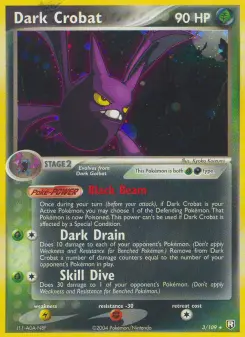
In Scarlet & Violet sets the reverse is dearer on 90% of pairs at a median 1.29x, and in Sword & Shield on 81% at 1.25x. The ratios peak on the cheapest cards: Omastar from 151 runs $1.78 reverse against a $0.30 holo, 5.9x, and Stellar Crown commons like Melmetal triple their holo row from a base of seven cents. The one expensive exception is vintage: Dark Crobat from Team Rocket Returns at $175.58 reverse against a $31.35 holo, with Jumpluff behind it at 3.2x. EX era reverses were genuinely scarce pulls, and the market pays for it: 87% of EX era pairs go to the reverse.
Where the holo takes it back
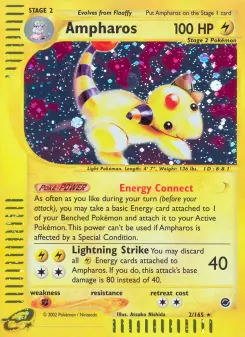
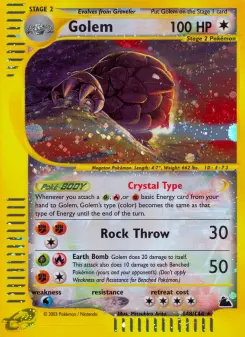
Filter the 350 pairs to the 53 where either finish is worth $20 or more and the picture inverts: the median falls to 0.78x and the holo is the dearer side in 64% of them. The pattern is starkest in the e-Card era, the oldest block in this census. The finish itself debuted months earlier in Legendary Collection, which prices too few same-day pairs to measure. Across 36 Expedition and Skyridge pairs the reverse wins 5, and the median is 0.56x. Ampharos trades at $175.00 holo against $54.62 reverse, Clefable $157.65 against $51.43, and Golem in Skyridge holds a $1,387.99 holo against a $599.99 reverse. When a card's holo is the chase, the reverse is the consolation, and the market prices it that way.
Reverse against holo, by era
| Era | Pairs | Median reverse / holo | Reverse dearer |
|---|---|---|---|
| e-Card (Expedition, Skyridge) | 36 | 0.56x | 14% |
| EX | 15 | 1.25x | 87% |
| Sun & Moon | 13 | 1.11x | 77% |
| Sword & Shield | 243 | 1.25x | 81% |
| Scarlet & Violet | 40 | 1.29x | 90% |
Population: English catalog cards whose TCGdex printing flags confirm both a holo and a reverse holo printing, and whose TCGplayer product prices both a Holofoil and a Reverse Holofoil row above zero in our September 7, 2026 per-printing data. That is 350 pairs. The catalog-flag restriction exists because products can carry a Holofoil row for cards never printed as set holos, and those ghost rows would contaminate the comparison; the unfiltered pair count is 641 and shows the same direction. Both legs of every ratio are same product, same day, same venue. Era assignment follows set id prefixes. Medians on even-sized samples take the upper middle element rather than averaging the two. Sample sizes are printed on every median; the DP through XY block holds only 3 pairs and is omitted from the era table. RECHECKED 2026-09-22: the per-printing block is a current-state cache with no history, and only 105 of today's 1,044 flag-confirmed pairs still carry a printing block written before September 8, so the September 7 census cannot be replayed at its date. Every named card reproduces to the cent: Dark Crobat $175.58 against $31.35, Golem $1,387.99 against $599.99, Clefable $157.65 against $51.43, Omastar 5.9x, Jumpluff 3.2x. The census itself has grown from 350 pairs to 1,044 as printing coverage filled in, and on that larger population the reverse is dearer on 70.4% of pairs at a median 1.23x, with the $20-and-up subset now 312 pairs at a 0.93x median and the holo dearer in 54.5%. The direction of both findings survives; the magnitudes soften. The e-Card block is the one that barely moves, 37 pairs at 0.58x with the reverse ahead on 18.9%. Two blocks that had too few pairs to print then are now large and were not measured here: DP through HGSS at 233 pairs and 0.85x, and WotC at 19 pairs and 4.57x.